

-2%
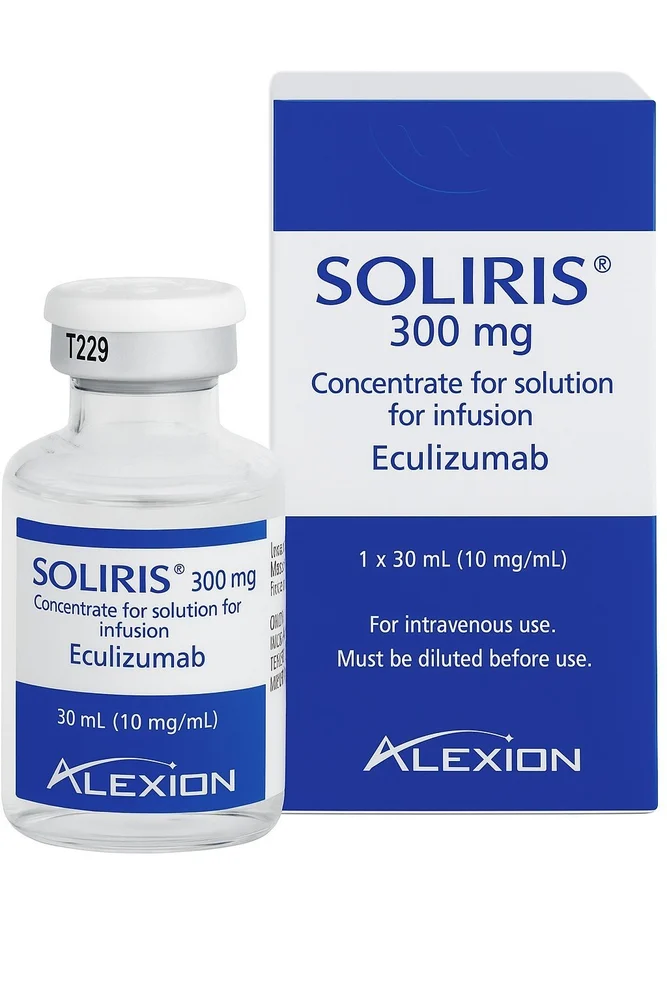
Soliris is use for the treatment of patients with paroxysmal nocturnal hemoglobinuria (PNH) to reduce hemolysis, the treatment of patients with atypical hemolytic uremic syndrome (aHUS) to inhibit complement-mediated thrombotic microangiopathy, the treatment of adult patients with generalized Myasthenia Gravis (gMG) who are anti-acetylcholine receptor (AchR) antibody positive, and neuromyelitis optica spectrum disorder (NMOSD) in adult patients who are anti-aquaporin-4 (AQP4) antibody positive. SOLIRIS is not indicated for the treatment of patients with Shiga-toxin E. coli-related hemolytic uremic syndrome (STEC-HUS). It is not known if SOLIRIS is safe and effective in children with PNH, or gMG, or NMOSD.
$2,200.00 Original price was: $2,200.00.$2,150.00Current price is: $2,150.00.
Guaranteed Safe Checkout

Managing rare, severe, and life-threatening complement-mediated disorders—such as paroxysmal nocturnal hemoglobinuria, atypical hemolytic uremic syndrome, refractory generalized myasthenia gravis, and neuromyelitis optica spectrum disorder—requires a precision-engineered, high-potency monoclonal antibody capable of blocking the complement cascade. When unregulated or hyperactive complement activation targets the body’s own red blood cells, vascular endothelium, neuromuscular junctions, or central nervous tissue, the resulting destruction causes profound organ damage, hemolytic anemia, thrombosis, and physical disability.
Left unmanaged, these progressive autoimmune and genetic conditions lead to catastrophic organ failure, recurrent debilitating relapses, permanent neurological or visual deficits, and life-threatening systemic complications.
Relying on generalized immunosuppression or supportive care alone is frequently insufficient to halt the specific terminal complement-mediated destruction driving these pathologies.
To provide targeted, high-affinity molecular inhibition backed by extensive clinical trials and global regulatory approvals, medical specialists rely on gold-standard complement inhibitors. Soliris Injection ($300\ \text{mg}$ / $30\ \text{mL}$ single-dose vial) (manufactured by Alexion Pharmaceuticals) is a premier, professional-grade biological therapy powered by Eculizumab at a concentration of $10\ \text{mg/mL}$ ($300\ \text{mg}$ total per $30\ \text{mL}$ clear, colorless sterile vial). Formulated as a concentrate for intravenous infusion, Soliris delivers unmatched terminal complement suppression engineered specifically for complex systemic disease management.
Soliris delivers a targeted biochemical mechanism engineered to bind to complement protein C5, preventing its cleavage and halting the downstream inflammatory cascade:
                  [Soliris 300 mg / 30 mL Eculizumab Diluted & Administered Intravenously]
                                              |
                   [Rapid Distribution into Systemic Blood Plasma Pools]
                                              |
               [High-Affinity Binding to Human Complement Protein C5]
                                              |
               -------------------------------------------------
              |                                                 |
     [BLOCKADE OF C5 CLEAVAGE]                   [PREVENTION OF TERMINAL COMPLEX]
   (Prevents Splitting into C5a and C5b)       (Inhibits Assembly of Membrane Attack Complex C5b-9)
              |                                                 |
              v                                                 v
   [Suppression of Anaphylatoxin C5a]          [Protection of Cell Membranes]
   (Reduces Pro-Inflammatory Signaling)        (Prevents Hemolysis & Endothelial Damage)
              |                                                 |
              v                                                 v
   [Inhibition of Neutrophil Activation]       [Preservation of Tissue & Organ Function]
   (Limits Vascular Thrombosis & Microangiopathy) (Halts Renal, Muscular, & Neural Decline)
              |                                                 |
               =========================> <=====================
                                              |
                                              v
                   [Complete Stabilization of Terminal Complement Homeostasis]
                                              |
                   [Normalized Red Blood Cell Survival, Protected Organs, & Restored Function]
Eculizumab is a recombinant humanized monoclonal antibody ($\text{IgG2/4}\kappa$) that specifically binds to the human complement protein C5 with high affinity, blocking its cleavage into C5a and C5b. By stopping this cleavage, Soliris prevents the generation of the terminal complement membrane attack complex ($\text{C5b-9}$), protecting vulnerable cells (such as red blood cells in PNH and endothelial cells in aHUS) from immune-mediated destruction and reducing pro-inflammatory cytokine signaling.
Intravenous Bioavailability: Delivered directly into the systemic circulation via intravenous infusion, achieving immediate maximum therapeutic concentration.
Persistent Complement Suppression: Maintains consistent terminal complement blockade throughout the standard dosing interval, requiring scheduled maintenance infusions to prevent complement rebound.
Soliris 300 mg Injection is indicated for the treatment of rare, severe immune and genetic conditions:
Paroxysmal Nocturnal Hemoglobinuria ($\text{PNH}$): Reduces hemolysis and clinical symptoms in patients with high disease activity, regardless of transfusion history.
Atypical Hemolytic Uremic Syndrome ($\text{aHUS}$): Inhibits complement-mediated thrombotic microangiopathy ($\text{TMA}$) to protect renal function and prevent systemic microvascular clotting.
Refractory Generalized Myasthenia Gravis ($\text{gMG}$): Treatment in adult and pediatric patients aged 6 years and older who are anti-acetylcholine receptor ($\text{AChR}$) antibody-positive and remain symptomatic despite standard therapies.
Neuromyelitis Optica Spectrum Disorder ($\text{NMOSD}$): Treatment in adult patients with a relapsing course who are anti-aquaporin-4 ($\text{AQP4}$) antibody-positive.
To guarantee absolute sterility, proper osmolarity, and patient safety, Soliris must be diluted prior to administration and infused strictly under medical supervision.
1.Inspect Vial & Dilute to 5 mg/mL:Aseptic Preparation.
Examine the $30\ \text{mL}$ glass vial for clarity. Withdraw the required volume and dilute it using 0.9% Sodium Chloride, 0.45% Sodium Chloride, 5% Dextrose in Water, or Ringer’s Injection to a final concentration of $5\ \text{mg/mL}$.
2.Administer via Intravenous Infusion:Infusion Delivery.
Infuse the diluted solution intravenously over 25 to 45 minutes (adults) or 1 to 4 hours (pediatric patients) via gravity feed or an infusion pump. Do not administer as an IV push or bolus.
3.Execute Weekly Loading Doses:Initial Induction Phase.
Follow the prescribed initial phase—typically weekly infusions for the first 4 weeks—depending on the specific clinical indication and patient weight.
4.Transition to Long-Term Intervals:Maintenance Phase.
Proceed to maintenance dosing starting at week 5 (e.g., every 2 weeks for adults, or tailored intervals for pediatric patients).
The table below outlines standard operational parameters for adult Soliris therapy across approved indications:
| Indication Category | Initial Induction Phase | Maintenance Phase Schedule | Final Admixture Infusion Volume |
| Paroxysmal Nocturnal Hemoglobinuria (PNH) | $600\ \text{mg}$ weekly for 4 weeks | $900\ \text{mg}$ at week 5, then every 14 days | $180\ \text{mL}$ ($900\ \text{mg}$ dose) |
| Atypical Hemolytic Uremic Syndrome (aHUS) | $900\ \text{mg}$ weekly for 4 weeks | $1,200\ \text{mg}$ at week 5, then every 14 days | $240\ \text{mL}$ ($1,200\ \text{mg}$ dose) |
| Generalized Myasthenia Gravis (gMG) | $900\ \text{mg}$ weekly for 4 weeks | $1,200\ \text{mg}$ at week 5, then every 14 days | $240\ \text{mL}$ ($1,200\ \text{mg}$ dose) |
| Neuromyelitis Optica Spectrum Disorder (NMOSD) | $900\ \text{mg}$ weekly for 4 weeks | $1,200\ \text{mg}$ at week 5, then every 14 days | $240\ \text{mL}$ ($1,200\ \text{mg}$ dose) |
Boxed Warning for Serious Meningococcal Infections: Due to its mechanism of action, Soliris significantly increases susceptibility to serious, life-threatening infections caused by Neisseria meningitidis. Patients must be vaccinated against meningococcal infections at least 2 weeks prior to receiving their first dose, and receive prophylactic antibiotics if treatment must be started urgently.
Infusion Reactions: Mild-to-moderate infusion reactions (such as headache, nausea, or fatigue) may occur. If an adverse reaction occurs, the infusion rate may be slowed or temporarily stopped.
Cold-Chain Storage Requirements: Unopened vials must be stored refrigerated between 2°C and 8°C (36°F to 46°F) in the original carton to protect from light. Do not freeze. Diluted solutions should be used immediately or stored under refrigeration for no longer than 24 hours.
Soliris contains Eculizumab, a recombinant humanized monoclonal antibody that targets and inhibits the terminal complement protein C5.
Because Soliris blocks terminal complement activation, it impairs the body’s primary defense mechanism against encapsulated bacteria like Neisseria meningitidis, making vaccination and continuous monitoring critical.
For adult patients, the diluted intravenous infusion is typically administered over 25 to 45 minutes. For pediatric patients, infusions generally range from 1 to 4 hours.
You can safely source authentic, pharmaceutical-grade Soliris 300 mg / 30 mL Vials online through Equines Vet Care. We store all specialized biological and temperature-sensitive specialty therapeutics under rigorous clinical cold-chain controls to guarantee absolute product freshness, safety, and full potency.
At Equines Vet Care, we understand that managing complex complement-mediated disorders requires absolute product authenticity and uncompromising cold-chain compliance. Every single vial of Soliris 300 mg Injection is sourced through authorized pharmaceutical distribution channels, maintained in our specialized medical refrigeration units, and shipped securely with temperature-monitored packaging.
patients with a disease called Paroxysmal Nocturnal Hemoglobinuria (PNH).
adults and children with a disease called atypical Hemolytic Uremic Syndrome (aHUS). SOLIRIS is not for use in treating people with Shiga toxin E. coli related hemolytic uremic syndrome (STEC-HUS).
adults with a disease called generalized myasthenia gravis (gMG) who are anti-acetylcholine receptor (AChR) antibody positive.
adults with a disease called neuromyelitis optica spectrum disorder (NMOSD) who are anti-aquaporin-4 (AQP4) antibody positive.
It is not known if SOLIRIS is safe and effective in children with PNH, gMG, or NMOSD.
IMPORTANT SAFETY INFORMATION
What is the most important information I should know about SOLIRIS?
SOLIRIS is a medicine that affects your immune system and can lower the ability of your immune system to fight infections.
SOLIRIS increases your chance of getting serious and life-threatening meningococcal infections that may quickly become life-threatening and cause death if not recognized and treated early.
You must receive meningococcal vaccines at least 2 weeks before your first dose of SOLIRIS if you are not vaccinated.
If your doctor decided that urgent treatment with SOLIRIS is needed, you should receive meningococcal vaccination as soon as possible.
If you have not been vaccinated and SOLIRIS therapy must be initiated immediately, you should also receive 2 weeks of antibiotics with your vaccinations.
If you had a meningococcal vaccine in the past, you might need additional vaccination. Your doctor will decide if you need additional vaccination.
Meningococcal vaccines reduce but do not prevent all meningococcal infections. Call your doctor or get emergency medical care right away if you get any of these signs and symptoms of a meningococcal infection: headache with nausea or vomiting, headache and fever, headache with a stiff neck or stiff back, fever, fever and a rash, confusion, muscle aches with flu-like symptoms, and eyes sensitive to light.
Your doctor will give you a Patient Safety Card about the risk of meningococcal infection. Carry it with you at all times during treatment and for 3 months after your last SOLIRIS dose. It is important to show this card to any doctor or nurse to help them diagnose and treat you quickly.
No account yet?
Create an Account
Reviews
There are no reviews yet.